
1. a large drawing pad.
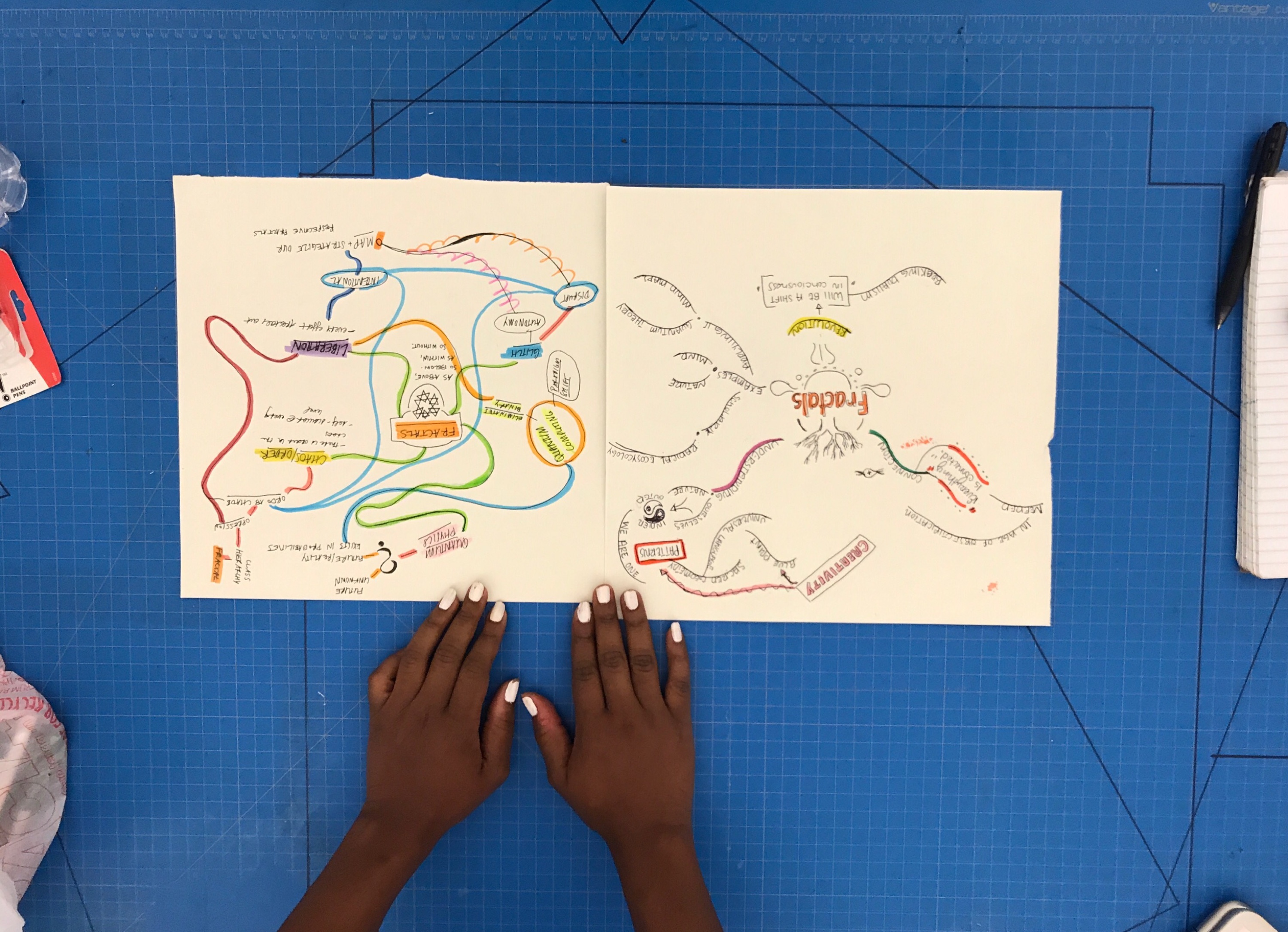
most recently disturbed blank pages feature mind maps, automatic writing, affirmations, and to-do lists. mind maps with nuclei like ‘fractal project’ or ‘afrofuturism’; derivatives like ‘use of music + dance to communicate that which may only occur in some future: be it the first sign of spring, the hour before the rooster moans, or the three hours massa and his family are away at sunday service.’ automatic writing about John Coltrane, my former residencies, my potential futures. affirmations to clarify them. to-do lists to reel them in. to-do list with practicalities like «create a reality and stay in it.»
2. a rough draft of a grant application.
written by my supervisor. CC’d to me because i am her assistant, student, and someone with an opinion she respects.
section headers that read «INTRODUCTION AND NARRATIVE’ and ‘EXPECTED OUTCOMES AND OBJECTIVES’. highlighted passages that reflect statements such as «This grant will provide funding to create a new Social Justice Symposium. The symposium will be open to all students, faculty, and staff from our college; as well as community activists, organizers, and social justice organizers. [. . . ] Students, scholars, and practitioners will be invited to present on a variety of topics related to social justice, including its meaning; application; and integration.» beyond this, it is full of generalities. diversity and inclusion, social justice, islamophobia.
a lot of the text makes my vessels constrict simply on principle: any narrative in favor of nipping a problem at its bud rather than its root (and that, of course, is after soil samples have been taken, seeds have been identified, and pollination potential has been neutralized) is a narrative i cannot tune into. generalities generate generalized results. liberation is a high-maintenance entity, demanding we make way for her with precision. our actions must be specific to the different ratios, proportions, and conjunctures oppression exist on.
2. [ALTERNATE] a rough draft of a grant application.
written by my supervisor. CC’d to me because i am employed as her assistant, am a student at the school the application concerns itself with, and a person with an opinion of which she has been known to respect.
application features an intent, a plan for fulfilling that intent, and a vision for the projected coalesce of mind and surrounding matter:
[INTENTION]»proposal to create a new Social Justice Symposium»
[PLAN OF ACTION]»Students, scholars, and practitioners will be invited to present on a variety of topics related to Social Justice including its meaning, application, and integration.»
[PROJECTED COALESCE] «[A heightened ease of control over] one’s own assumptions and convictions about social justice and the ability to communicate a personal vision for social justice; as well as development of new partnerships across disciplines and institutions to engage in social justice work.
application’s full text initially felt a bit barren to me — the intentions as a carcass of what we should be. as if we were showing up to the brawl as a carcass, while our opponent was clad too in bone, but also blood, meat, muscle, epidermis. but then i remember the only time is now, that all the timelines somehow fit into one another — lunar fits in gregorian fits in quantum fits in solar fits in; i remember plantation economy became industrial economy; i remember Dr. John Henrik Clarke saying «all of history is a current event. everything that did happen is still happening,».
the grant proposal does not promise a quick ‘righting’ of all that is wrong; but it does outline real-time ways to inch our truth + resiliency and the assailants on that truth and resiliency closer together, for the eternal final showdown.
bone is as important as blood as is meat as is muscle as is epidermis. the general is the specific. a light there is a shadow here. the multiplicity of perspective from the students, staff, scholars will, by natural law, yield multiplicity of tactic for students, staff, scholars, etc. to perform. people exist at different ratios, proportions, and conjunctures — just like oppression.
3. an ecopsychology textbook.
inside the front cover, a past student here signed her name. the person i borrowed the book for is not the person that signed the inside cover; the person that signed the front cover is not the person who annotated the bulk of the textbook.
3. [CONTINUED]a forest green binder.
inside it is a concept bank full of phrases like ‘linguistics’, ‘neuroplasticity’, ‘SPONCH (Sulfur Phosphorous Nitrogen Carbon Hydrogen).
im trying this new thing where my interests, debt unto them, and action to redeem that debt are accounted for. doing the opposite is a disrespect unto the spirits that choose to move through me. ‘ecopsychology’ is another term in the concept bank. i make the case for my curiosity by saying:
«. . . the subtle ecological, biochemical, and evolutionary connections between the socially-acclimated human, the Homo sapien, and the remaining life forms situated in the taxonomic rank are not receiving enough attention.
Evolution did not end with our gaining of opposable thumbs. The universe is still expanding — and humans haven’t ‘transcended’ the snares of evolution, even with our computers and intelligence. Evolutionary occurrences, such as natural selection or adaptation, just look a bit different now that it did 5 million years ago.
Questioning, and identifying with precision, what key concepts such as adaptation do and do not look like in our era is crucial. There are now a multitude of contexts in which me much all adapt in: economically, geopolitically, socioculturally, and so on.
What if adaptation is a privilege experienced only by the white, cis-gendered, heteronormative elite? What if natural selection in Homo sapiens is now determined by who assimilates into the dominant, oppressive culture?»
 subatomic thoughts